
About cookies on this site Our websites require some cookies to function properly (required). In addition, other cookies may be used with your consent to analyze site usage, improve the user experience and for advertising. For more information, please review your options. By visiting our website, you agree to our processing of information as described in IBM’sprivacy statement. To provide a smooth navigation, your cookie preferences will be shared across the IBM web domains listed here.
Blog post
How enterprise AI solves Java modernization challenges
Transform legacy Java applications faster with AI-powered automation and watsonx Code Assistant
If you're maintaining enterprise Java applications, you've probably spent weeks or even months analyzing legacy code just to understand what needs updating. Whether it’s a Spring Boot application with custom security configurations or a legacy Java codebase with deprecated APIs scattered across hundreds of classes, manual modernization of these systems is painful and error‑prone.
Most enterprise Java developers face the same bottlenecks when parsing millions of lines of code to map dependencies, manually refactoring framework-specific patterns, and updating configuration files that break in subtle ways. What’s more, the complexity of modernization multiplies when taking into consideration enterprise constraints. You can't just run automated updates. You need to maintain business logic, preserve security implementations, and ensure your changes work across integrated systems.
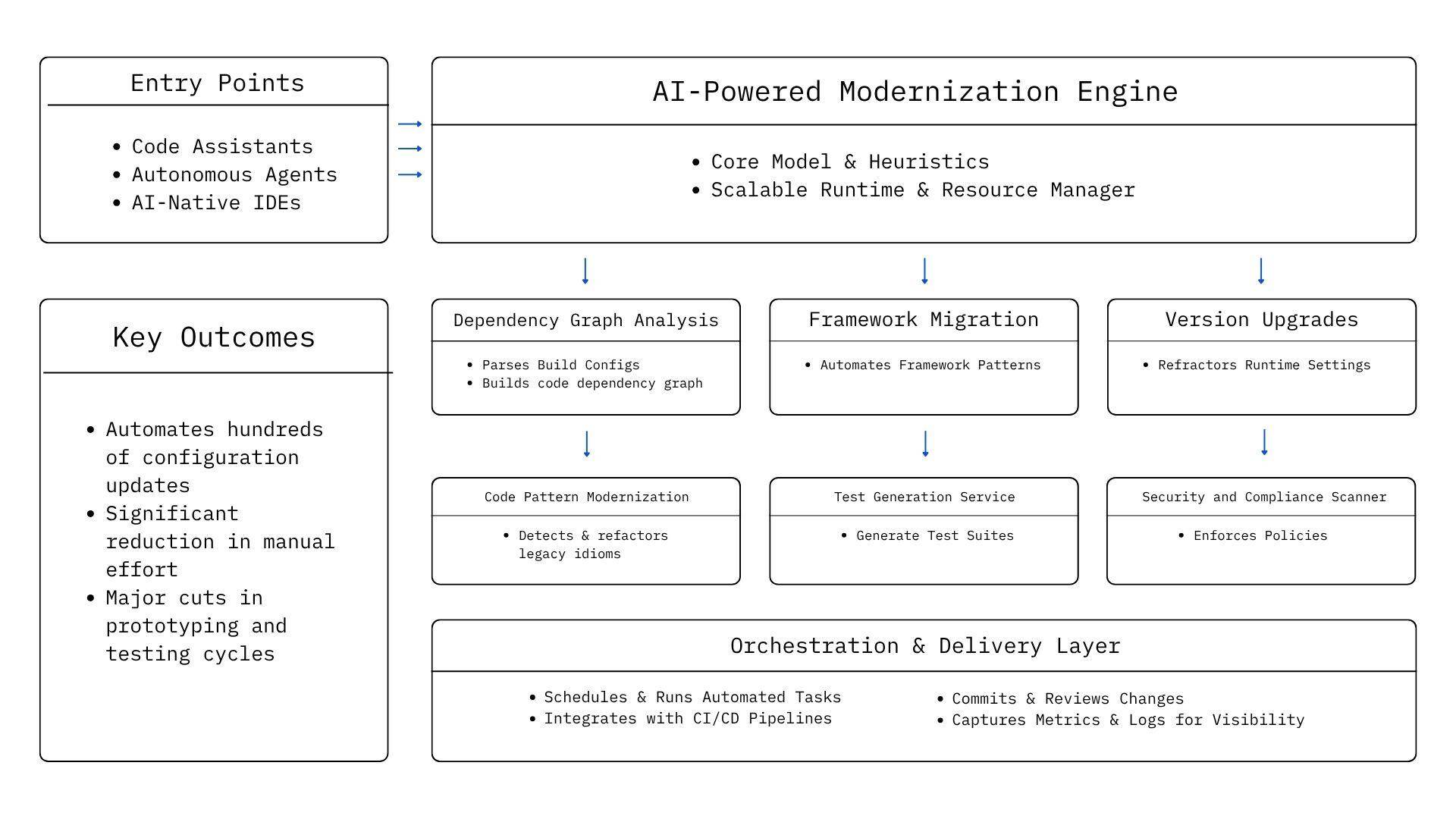
The next wave of AI-powered development tools will fundamentally transform how organizations modernize their legacy applications, with code assistants, autonomous agents, and AI-native IDEs leading the charge.
How AI transforms Java modernization
AI-powered tools automate the repetitive, error-prone tasks that consume most of your modernization time. Instead of manually updating hundreds of Maven dependencies, AI can analyze your entire dependency graph and make compatible updates automatically.
For example, here's what AI can handle for Java modernization:
- Framework migrations. Automatically migrate Spring Boot applications to newer versions, including security configurations, data access layers, and actuator endpoints, while preserving your existing functionality. AI understands end-to-end framework changes, so you can adopt the latest patterns with confidence.
Java version upgrades. Seamlessly upgrade your Java runtime to the latest supported version. AI identifies and replaces incompatible APIs, integrates with the modern module system, and handles complex refactoring required by newer language features.
Cloud-native and serverless architectures demand rapid "scale-to-zero" and back‑up of application instances, making subsecond startup times a critical factor for both performance and cost optimization. Modern runtimes can leverage checkpoint/restore technologies like InstantOn to enable environments that spin up in milliseconds without sacrificing throughput, and AI-driven automation can help orchestrate and optimize these high-performance deployments. (Read more about why Open Liberty is ideal for cloud-native Java applications.)
Code pattern modernization. Automatically refactor legacy WebSecurityConfigurerAdapter implementations into component‑based SecurityFilterChain beans, preserving your custom access rules and authorization logic. AI understands both patterns, streamlining migration workflows and reducing risk in complex enterprise environments.
- Test generation. Create comprehensive unit tests for refactored code, including edge cases that manual testing often misses.
Internal IBM validation shows 70% faster modernization timelines when combining traditional assessment tools with AI-powered code transformation.
Why watsonx Code Assistant works for enterprise Java
Generic AI coding tools often miss enterprise-specific context. IBM watsonx Code Assistant includes specialized features for Java enterprise applications and can use IBM Transformation Advisor migration bundles. It works with Maven builds to automate modernization scenarios through AI-generated fixes and prescriptive guidance.
Key capabilities of watsonx Code Assistant for Java developers:
- Enterprise Java modernization and version upgrades. Analyzes your runtime and codebase to create prescriptive plans, with complexity and effort estimates, for lighter runtimes or Java version upgrades, and applies automated and generative AI assisted refactoring to implement them.
- Enterprise-grade security and compliance. Built on IBM's Granite foundation models with IP indemnification, real-time similarity checks for code integrity, and compliance assessments ensuring your code meets enterprise standards without collecting usage data.
- Integrated development experience. Works seamlessly in Visual Studio Code and Eclipse IDEs with chat-based assistance, enhanced code explanations, automated unit test generation and fixing, plus code completion and documentation features within your existing workflow.
Building your AI modernization workflow
Start with a pilot project. Choose a self-contained Java service that represents your broader modernization challenges and use AI to handle routine transformations like dependency updates and framework migrations while you focus on architecture decisions.
- Step 1: Assessment and planning. Use tools like Transformation Advisor to identify modernization candidates. Put a focus on services that deliver clear business value and aren't overly complex for your first AI-assisted project.
- Step 2: Automated transformation. Use AI coding assistants and agents to automate repetitive tasks such as updating configurations, refactoring deprecated APIs, and generating test cases. Review AI-generated changes to understand the patterns and build confidence in the approach.
- Step 3: Validation and testing. AI tools often produce code with better error handling and more complete testing than manual rewrites. Review that the changes align with your business requirements and integrate well with your other systems.
- Step 4: Scale and iterate. Once your team is comfortable with AI workflows, apply them to larger services and more complex transformations. Track metrics like time savings, code quality improvements, and reduced manual review cycles to measure ROI and further justify AI adoption across your organization.
Through this approach, AI handles the routine, error-prone tasks so that you can focus on which tasks demand human expertise such as architecture decisions, business logic validation, and technical design choices.
Getting started with AI-powered Java modernization
The tools are available now, and early adopters report dramatic gains in modernization pace and code quality. You’ll find the learning curve shorter than you expect, and the productivity boost nearly instantaneous.
Don’t let legacy Java apps stall your development momentum. Kick off a small pilot project today.
Sign up for the free trial of watsonx Code Assistant and see the watsonx Code Assistant documentation for quickstart instructions and discover further how AI can accelerate your next modernization.