
About cookies on this site Our websites require some cookies to function properly (required). In addition, other cookies may be used with your consent to analyze site usage, improve the user experience and for advertising. For more information, please review your options. By visiting our website, you agree to our processing of information as described in IBM’sprivacy statement. To provide a smooth navigation, your cookie preferences will be shared across the IBM web domains listed here.
Article
Model Context Protocol architecture patterns for multi-agent AI systems
Learn how Model Context Protocol enables scalable, modular multi‑agent AI architectures through client, server, and hybrid LLM placement patterns with real‑world design trade‑offs
On this page
Designing and managing multiple AI agents is complex. Traditional API patterns often fail to meet the needs of dynamic, real-time AI workflows. The Model Context Protocol (MCP) solves these challenges by providing a standardized, context-aware communication framework that is different from REST APIs. MCP uses Server-Sent Events (SSE) for low-latency, two-way data exchange. This enables scalable and adaptive multi-agent systems.
As MCP adoption grows, architects face important design decisions:
- Should large language models (LLMs) run on MCP servers for centralized control and reusability?
- Should LLMs run on the client side for flexibility and dynamic orchestration?
- Or should a hybrid architecture combine the strengths of both options?
This article focuses on architectural approaches, their tradeoffs, and introduces a hybrid model that balances reusability, scalability, and dynamic orchestration. The goal is to help you build robust and future-proof multi-agent AI systems.
MCP is different from traditional API approaches. MCP is based on three main principles:
- Tool-based operations: Agents interact through standardized tools instead of fixed endpoints. MCP provides semantic tools that include business logic. For example, instead of using a generic
/api/documentsendpoint, you create a tool calledretrieve datathat includes domain-specific validation, formatting, and context awareness. - Persistent context: MCP maintains the state across interactions. This allows AI agents to build on previous operations without rebuilding context. This is important for multi-step processes where each step depends on the previous one.
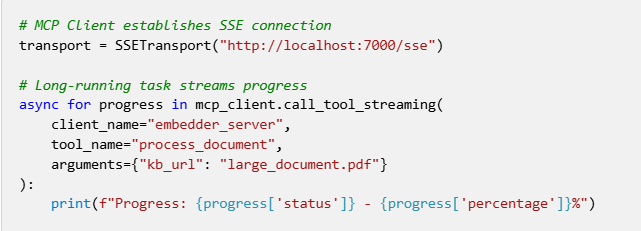
- Streaming communication: MCP uses Server-Sent Events (SSE) for real-time updates during long-running AI tasks. Clients receive progress updates, intermediate results, and streaming responses without polling. This is essential for operations such as data embedding or content generation with LLMs that may take several minutes. SSE supports low-latency, continuous updates, which are critical for dynamic multi-agent systems.
Architectural approaches for MCP
Reusable AI agents (LLM with MCP server)
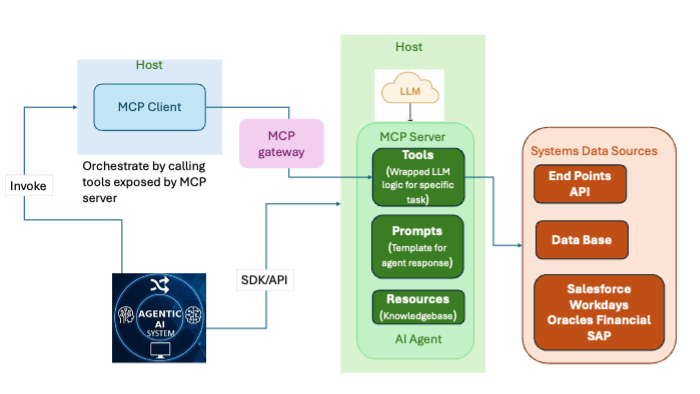
Figure 1: Reusable AI agent (LLM attached with MCP server)
Each MCP server acts as one AI agent. The LLM is attached to the MCP server. The MCP client communicates with the server to use the model.
MCP server components
- Tools: Functions that wrap LLM logic for specific tasks such as sentiment analysis or API calls.
- Prompts: Templates for agent responses.
- Resources: Knowledge bases or databases.
The MCP client works as an orchestrator. It calls tools that the MCP server exposes.
Pros and cons of reusable AI agents
The following table summarizes the advantages and disadvantages of this approach.
| Pros | Cons |
|---|---|
| Agents work as pluggable microservices. | May lose MCP standardized communication benefits, which creates tighter coupling and reduces dynamic orchestration. |
| Agents function as modular and reusable microservices or SDKs, suitable for scalability and system integration. | Risk of tighter coupling increases when agents are exposed as traditional SDKs or microservices, which reduces MCP orchestration benefits. |
| Agents can be reused across many AI systems. | Network communication can create latency and privacy concerns because data must be sent to the server. |
| Centralized servers make it easier to maintain, update, and scale the model. | |
| Clients do not need large storage or computing resources for the model. | |
| Clients always access the most recent model version without updating local copies. |
When to use reusable AI agents
Use the MCP for reusable agents only when dynamic orchestration is a priority. If your main goal is simplicity and easy integration with existing systems, do not use MCP. In that case, expose the agents as software development kits (SDKs) or microservices. This approach is simpler but removes MCP’s protocol-driven orchestration.
Strict MCP purity (LLM only in client)
In this approach, the MCP servers act as simple providers of tools, resources, data, and prompt templates. The MCP client hosts the LLM runtime and the agent logic. The client decides when to call MCP server tools.
The MCP server remains stateless, reusable, and replaceable. In this setup, the LLM usually runs on the user device or local environment. The MCP client communicates with the MCP server to use the shared model context.
Key advantages
- Sensitive data remains on the user device, which reduces the risk of data exposure.
- The LLM can continue to function without an internet connection when the model is available locally.
- Direct access to the LLM on the client can improve response time.
Key limitations
- The client requires more storage space.
- The client may have limited hardware capacity, which can reduce the model capability.
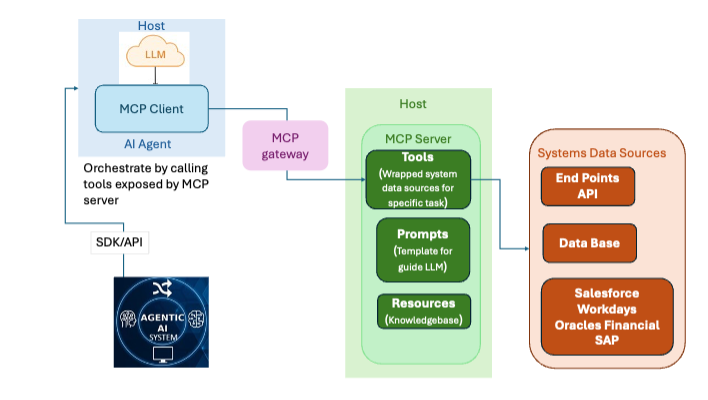
Figure 2: Strict MCP purity (LLM only in MCP client)
Pros and cons
The following table summarizes the strengths and limitations of the Strict MCP purity approach. This approach follows the canonical MCP design and favors decentralized, protocol driven systems.
| Pros | Cons |
|---|---|
| Follows the canonical MCP model. | The MCP client can become a bottleneck for logic as system complexity increases. |
| Supports stateless and interchangeable MCP servers. | System scalability becomes harder as the system grows. |
| Suited for dynamic and decentralized systems. |
When to use
Use the strict MCP purity approach when your system needs strong dynamic orchestration and clear protocol‑driven communication. Do not use this approach if your system requires high agent autonomy or independent decision‑making.
Hybrid MCP architecture
The Hybrid MCP Architecture combines reusable microservices or SDKs for stable tasks with MCP communication for context‑aware interactions. This architecture supports modular design and flexible distribution of logic between the MCP client and the MCP server.
In this setup, stable tasks such as data processing or API calls run as reusable microservices or SDKs. The MCP protocol adds context‑aware communication that supports dynamic interactions between components. The MCP client handles high‑level decisions, and the MCP server handles domain‑specific tasks.
The hybrid approach uses server‑side agents that host specialized tools, prompts, and resources for tasks such as customer support or fraud detection. The client‑side logic manages workflows, maintains state, and selects the right tools for each interaction. Hybrid agents connect server‑side capability with client‑side customization for use cases such as personalized recommendations or real‑time analytics.
The communication flow begins when the MCP client receives a user request such as resolving an order and recommending products. The MCP client selects the appropriate MCP servers or agents and delegates specific tasks such as order lookup or recommendation generation. The MCP client then gathers all results, applies the final logic, and sends a complete response to the user.
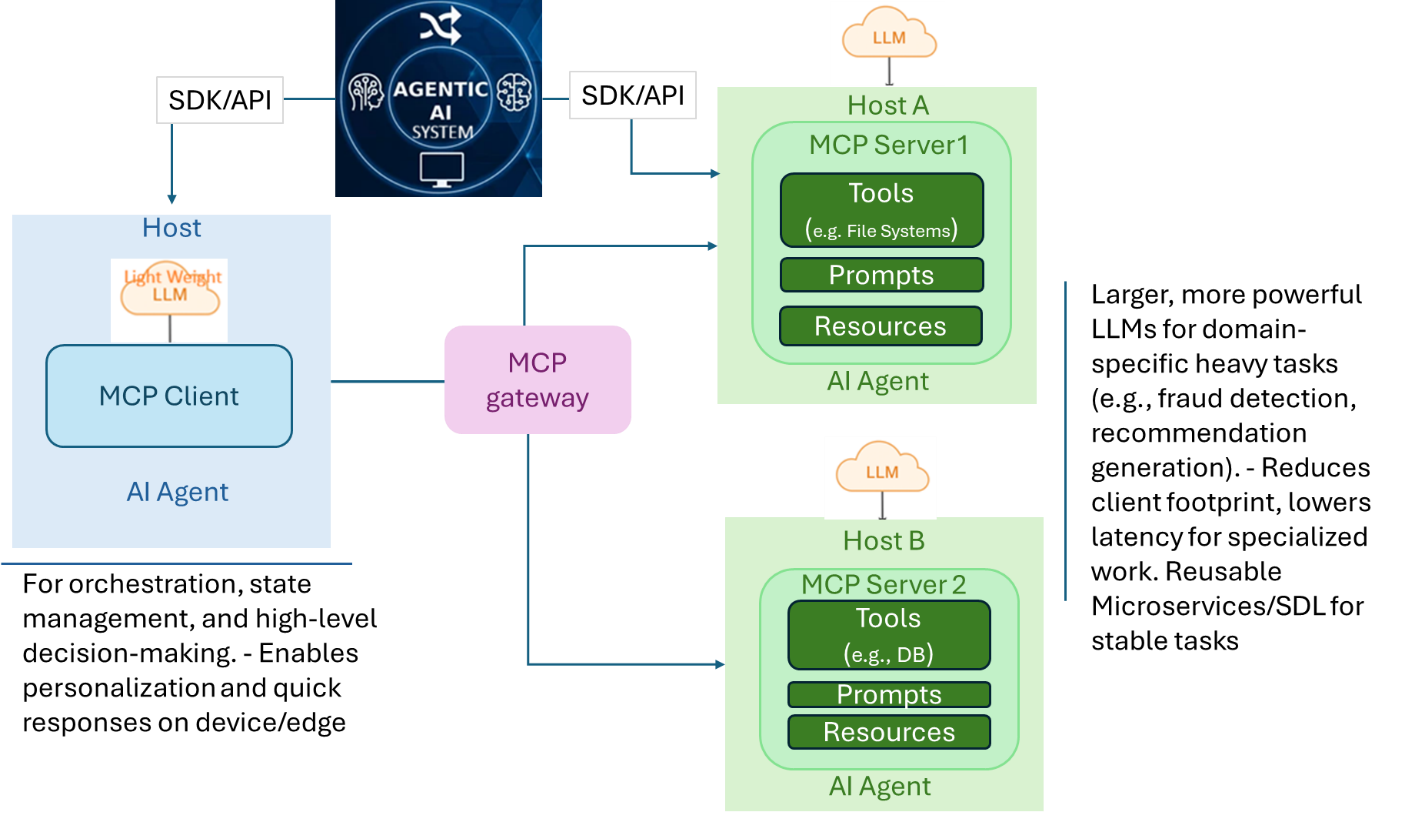
Figure 3: Hybrid MCP architecture: Strict MCP purity + LLM with MCP server
This architecture diagram highlights the hybrid structure of the MCP. It shows a clear separation between client‑side orchestration and server‑side specialized execution. The MCP protocol works as the communication bridge between the two sides.
The LLM footprint on the client can be kept small for better efficiency. The system can also use more powerful models on the server or distribute the model load across client and server based on the specific use case.
Advantages of the hybrid MCP architecture
- Supports reusability, flexibility, scalability, and MCP compliance.
- Reduces complexity and latency through clear boundaries and caching.
- Keeps server‑side agents pluggable and reusable.
- Allows client‑side logic to adapt to user context and select tools dynamically.
- Shares workload between servers for tools and clients for orchestration.
- Maintains MCP compliance through standardized communication for dynamic interactions.
- Supports reuse of server‑side agents across multiple systems.
- Enables client‑side logic to adapt to changing user needs.
- Preserves protocol‑driven communication for dynamic tool usage.
- Encourages clear separation between client logic and server logic.
- Improves server responses by caching commonly used tools and resources on the client.
Limitations and mitigation strategies
Hybrid systems can become complex if responsibilities are not defined clearly. Clear boundaries between client logic and server logic help reduce this complexity. Using standardized MCP communication also simplifies system integration.
Client to server communication can introduce delays. Caching frequently used tools and resources on the client helps reduce these delays. Optimizing MCP server responses further improves system performance.
Flexible LLM deployment options
The hybrid MCP architecture supports flexible placement of the LLM based on system needs.
- Server‑side LLM placement: The MCP server or agent runs a larger and more powerful LLM. This setup supports heavy domain tasks such as fraud detection and recommendation generation. It also reduces the model footprint on the client and lowers latency for specialized processing.
- Client‑side LLM placement: The MCP client uses a smaller or lightweight LLM, or no model, for orchestration, state management, and high‑level decisions. This setup supports personalization and fast responses on the user device or edge environment.
- Hybrid LLM placement: The system splits LLM inference between the client and the server using the MCP. The protocol passes context efficiently. This supports dynamic tool selection and modular distribution of logic across the system.
Entity relation: MCP client and MCP server
This architecture uses different combinations of relationships between the MCP client and the MCP server.
Single MCP client with single MCP server
This is the simplest setup. One host application creates one MCP client that connects to one MCP server. For example, an AI coding assistant connects to one GitHub repository server.
The host application collects context from the single MCP server. This setup is suitable for focused tasks such as accessing one database or one toolset. The MCP client manages all protocol actions, including the handshake process, capability discovery, and tool calls.
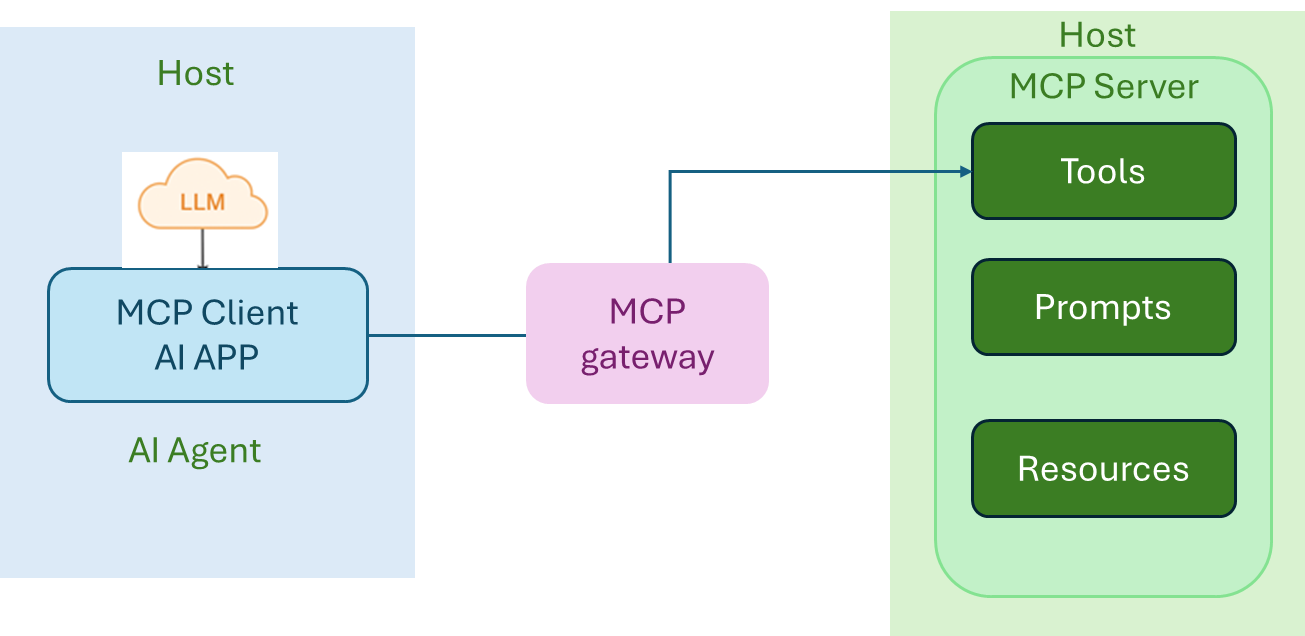 Figure 4. One MCP client : One MCP server
Multiple MCP clients with one MCP server
This setup appears when one MCP server is designed to support many MCP clients. This is common for remote servers that use HTTP or SSE transport.
Multiple host applications, or one host with multiple sessions, connect to the same shared MCP server. This setup is useful for collaborative tasks or cloud servers that support many users or many AI instances. A typical example is a shared database server.
The MCP server manages all active connections and keeps each session isolated when needed.
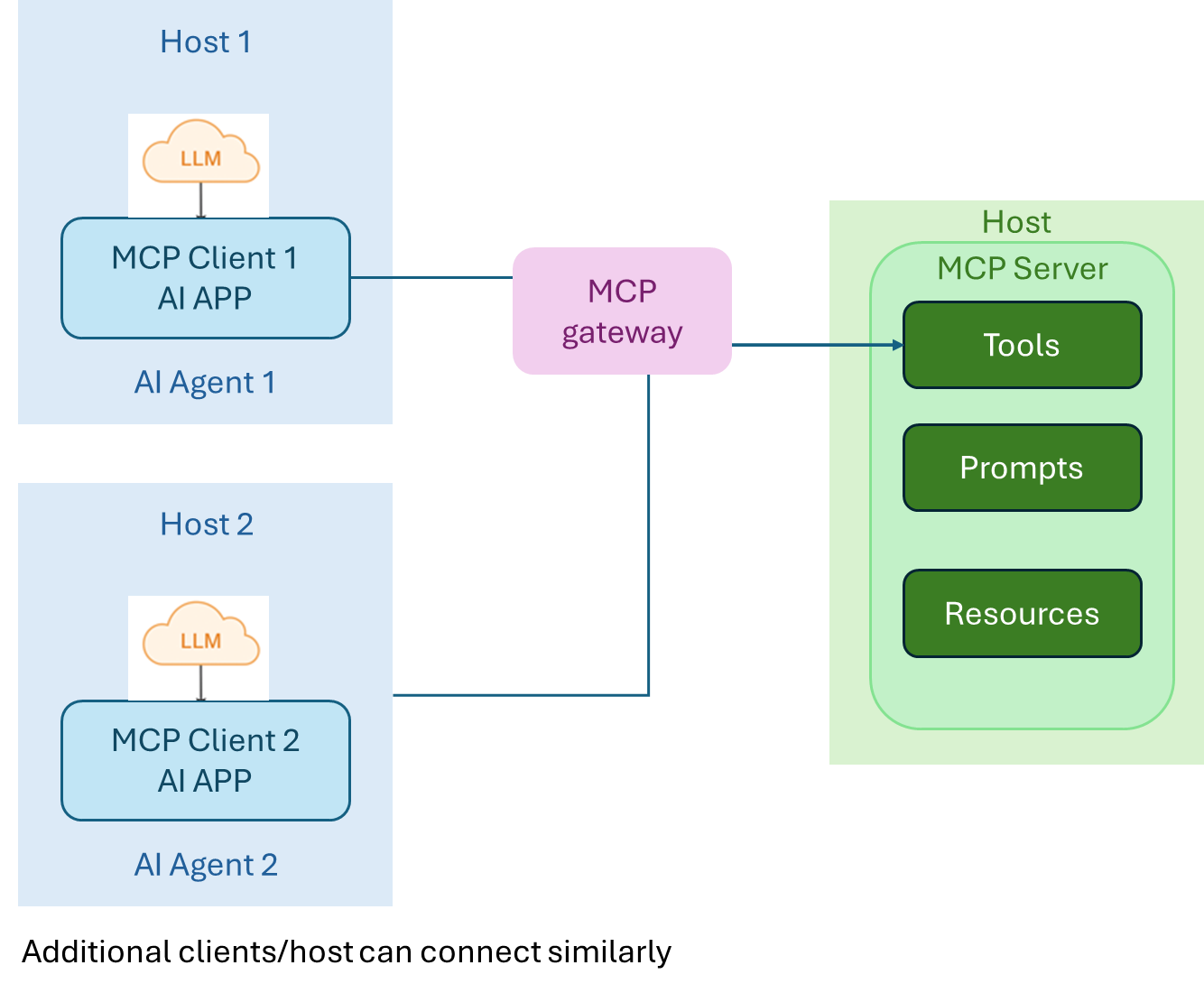 Figure 5. Multiple MCP clients : One MCP server
Multiple MCP clients with multiple MCP servers
This is the most common and scalable setup. One host application with multiple MCP clients connects to many MCP servers to collect rich context. For example, an AI agent can access files, databases, and APIs at the same time.
The host application creates one MCP client for each MCP server. The host then gathers all capabilities from all connected servers. The LLM can discover and use tools and resources from every server.
This setup supports modular design because servers can be added or removed easily. Remote MCP servers can also be shared across many host applications. This architecture supports secure and standardized integration and reduces the need for custom code for AI and tool connections.
A common real‑world example is the Claude Desktop application, which uses one host with multiple MCP clients that connect to multiple MCP servers.
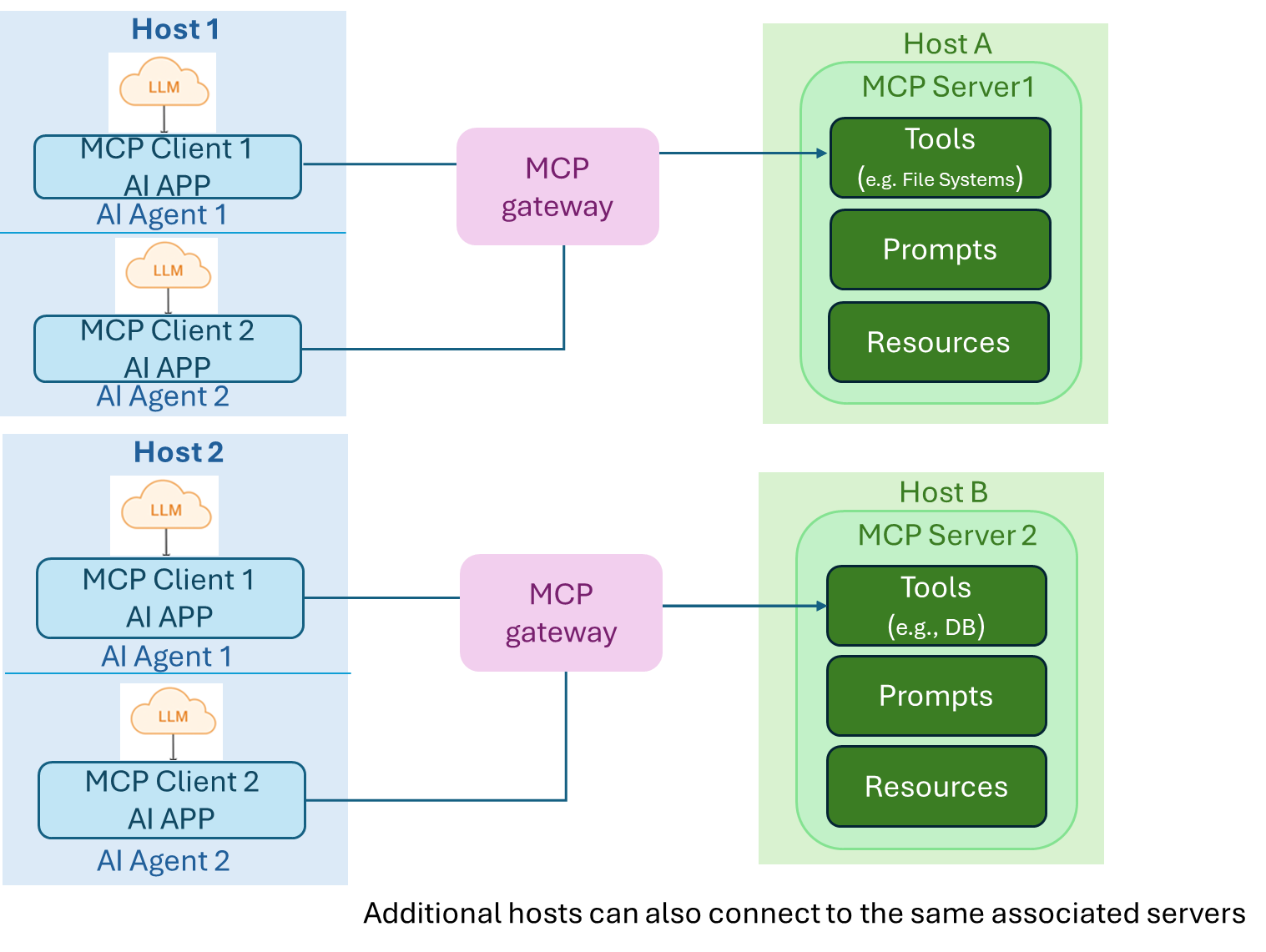
Figure 6. Multiple MCP clients : Multiple MCP servers
Training management system (TMS) case study
Modern enterprises face a growing need for automated and personalized training programs. Traditional learning management systems often cannot support these needs because they depend on manual course creation, static content, and uniform assessments.
A forward‑looking organization identified this gap and chose to build a next‑generation training management system (TMS) using a multi‑agent AI architecture. Instead of relying on manual work and fixed workflows, the organization designed an intelligent system in which specialized AI agents work together to convert raw training material into complete and personalized learning experiences.
Business requirements
The organization defined four main capabilities for the TMS.
- Training material analysis: The system must automatically analyze uploaded documents such as PDFs and presentations. It must extract key concepts, topics, and learning objectives.
- Course creation: The system must generate structured course content. This includes modules, lessons, and clear explanations based on the analyzed material.
- Self‑paced training: The system must allow learners to access course content at any time. It must provide clear learning paths and track learner progress.
- Self‑assessment: The system must generate assessments automatically. It must create multiple‑choice questions that match the course modules and help validate learner knowledge.
Technical requirements
The team defined the following technical requirements to support scalability and maintainability.
- Multi‑agent AI system: The system must break the work into specialized AI agents. Each agent must handle one clear task such as document processing, content analysis, content generation, or assessment creation.
- Reusable agents: Each agent must be an independent and reusable microservice. The agents must work in the TMS and in other systems.
- MCP protocol adoption: The system must use the MCP for standardized and context‑aware communication between the agents and the orchestration layer.
- Scalable architecture: The system must support asynchronous processing, horizontal scaling, and loose coupling. This ensures that the system can handle growing workloads.
TMS architecture: Hybrid MCP approach
The TMS uses a hybrid MCP architecture that combines server‑side and client‑side LLM deployment. This approach supports reusability, dynamic orchestration, and scalability.
The system uses the multi‑client to multi‑server model. It follows a hybrid structure that mixes strict MCP purity and LLM‑enabled MCP servers. The design is modular and agent based. Each layer has a clear responsibility, which improves scalability and maintainability.
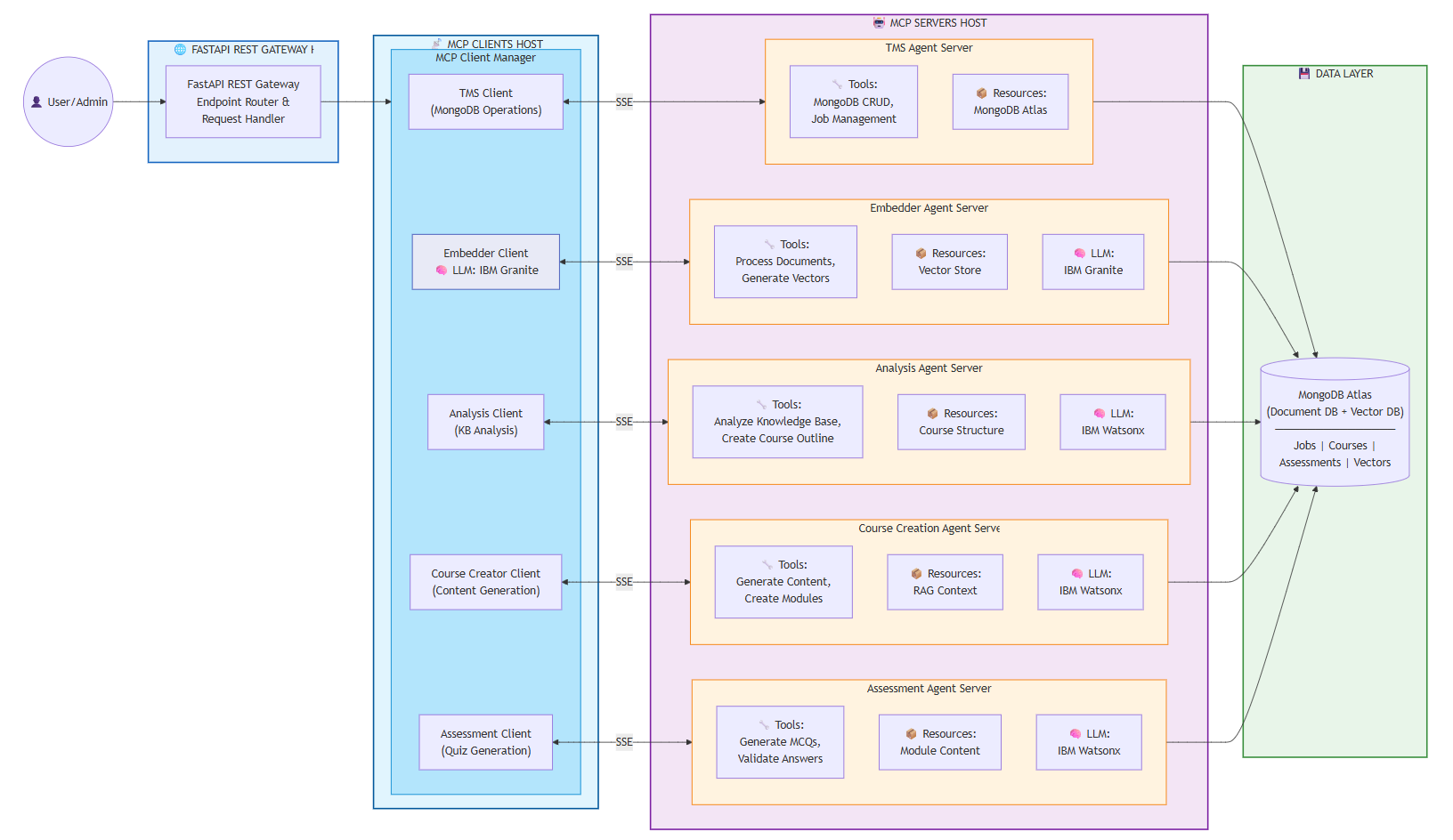
Figure 7. TMS system architecture follows Multiple Clients with Multiple Servers
View larger image
Architecture layers
The TMS uses a multi‑MCP client to multi‑MCP server pattern. The architecture contains several clear layers.
FastAPI REST gateway: Users and administrators interact with the system through a FastAPI REST gateway. This gateway is the single entry point for all requests. It routes requests and handles API tasks before sending the work to the correct agent.
MCP client layer: A centralized MCP Client Manager controls communication with five specialized MCP clients.
- TMS client: Handles MongoDB operations such as create, read, update, delete, and job management.
- Embedder client: Uses the IBM Granite model for document processing with vectorization knowledgebase.
- Analysis client: Performs analysis of the knowledge base.
- Course creator client: Generates training content.
- Assessment client: Creates quizzes and evaluations.
Agent server layer: This layer contains multiple MCP agent servers. Each MCP client connects to its matching MCP server using server‑sent events. Each MCP server is a self‑contained unit with:
- Tools: Specific capabilities such as vector generation, content creation, or question generation.
- Resources: Data sources such as vector stores, course structures, and module content.
- LLM integration: IBM watsonx or IBM Granite models that provide AI capability.
Data layer: All agents use a shared MongoDB Atlas instance. This instance supports two main roles.
- Document database: Stores jobs, courses, and assessments.
- Vector database: Stores embeddings for retrieval tasks.
This architecture enables the TMS to convert knowledge bases into structured training courses with assessments. The system depends on loosely coupled AI agents that work together through the MCP.
How MCP supports multi‑agent collaboration
The MCP is a key part of the TMS architecture. It supports clear communication and coordination between multiple AI agents.
Standardized tool invocation
Each AI agent exposes its functions as MCP tools instead of REST endpoints. This provides semantic and context‑aware interaction between the MCP client and the MCP server.
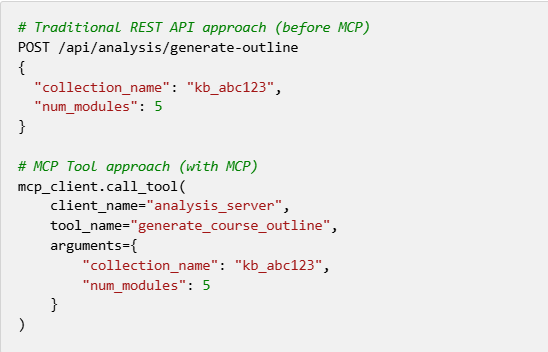
The MCP approach provides the following benefits:
- Type safety: Each tool defines input and output schemas.
- Context preservation: MCP keeps the state across interactions.
- Tool discovery: MCP clients can request a list of available tools dynamically.
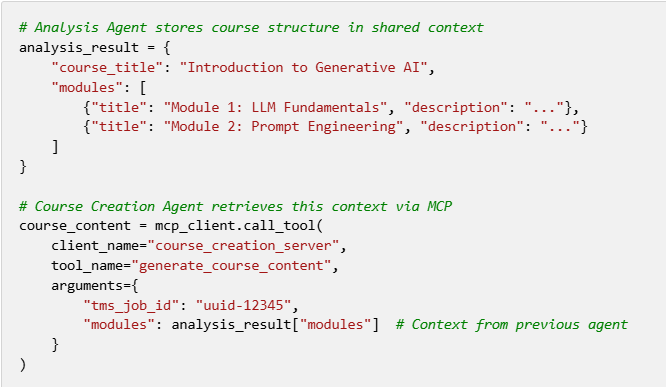
Persistent context across agent interactions
The MCP maintains context across every step in a multi‑step workflow. When the Course Creation Agent generates training content, it receives and uses the context produced by the Analysis Agent.
Server‑sent events for long‑running tasks
Document processing and content generation can take several minutes. The MCP uses Server‑Sent Events to send real‑time progress updates.
Detailed workflow: From PDF to complete course
This section explains the complete TMS workflow and shows how each agent works with the others.
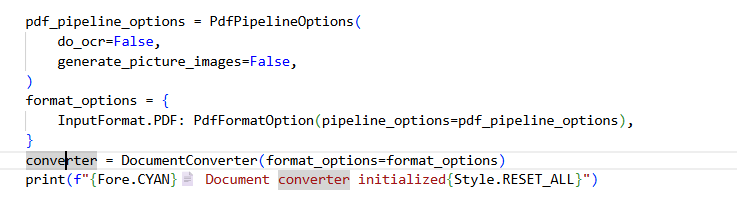
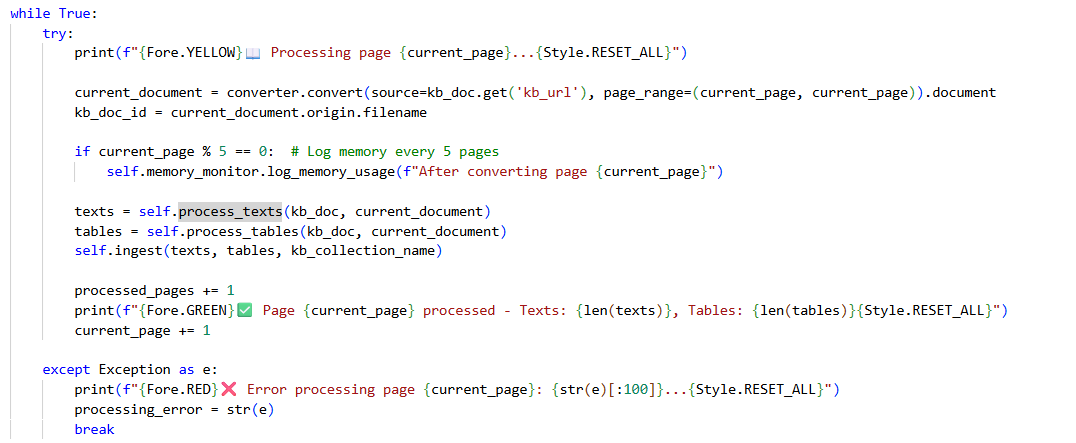
Step 1: Document upload and embedding (Embedder agent)
Trigger: An administrator uploads a PDF document through the REST API.
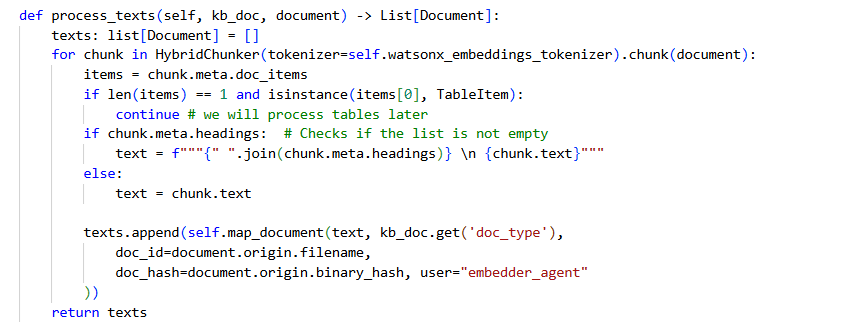
Step 2: Knowledge base analysis (Analysis agent)
Trigger: The administrator starts the analysis after the document embedding is complete.
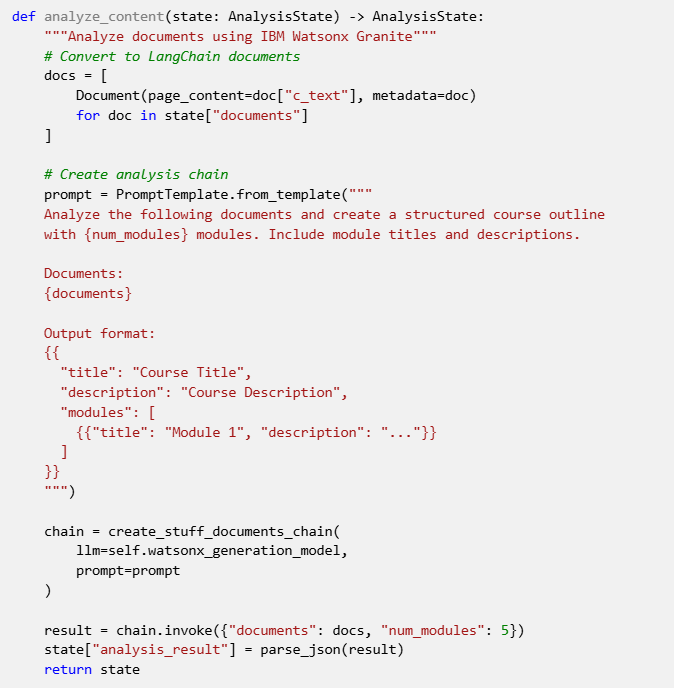
Step 3: Course content generation (Course creation agent)
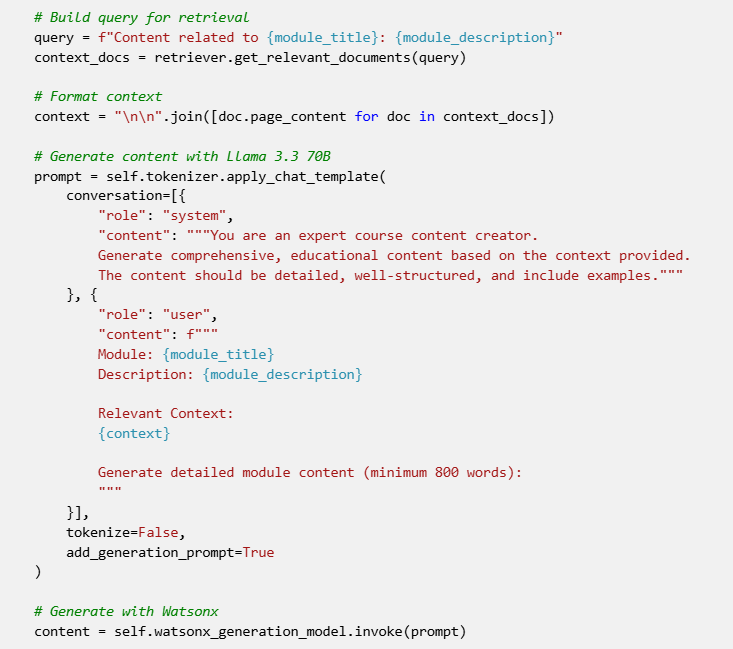
Step 4: Assessment Generation (Assessment agent)
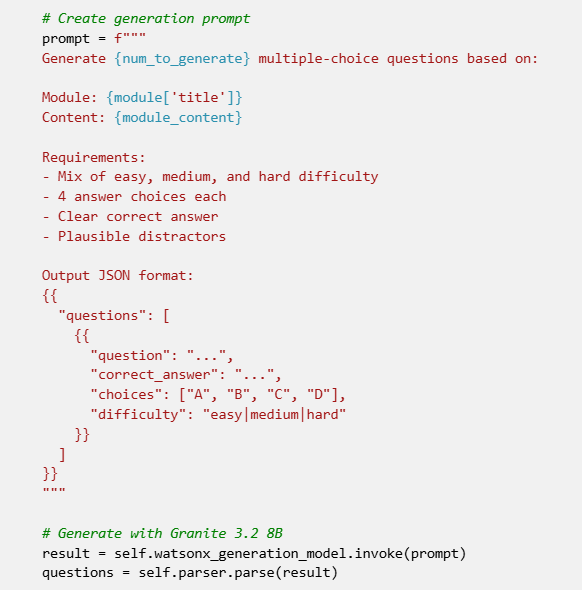
Conclusion: MCP as the foundation for intelligent systems
The TMS architecture follows the multiple MCP clients to multiple MCP servers pattern. It uses a hybrid MCP structure that combines strict MCP purity with LLM‑enabled MCP servers.
The system includes:
- One host application: FastAPI REST API handles all incoming requests.
- MCP client manager: The manager controls multiple MCP client connections. One of these clients includes an attached LLM.
Five MCP servers:
- TMS Server for MongoDB tools
- Embedder Server for document processing
- Analysis Server for course outline generation
- Course Creation Server for content creation
- Assessment Server for question generation
This pattern provides:
- Modularity: Agents can be added or removed easily.
- Rich context: The system collects capabilities from all agents.
- Dynamic tool discovery: The LLM can find and use tools across all servers.
- Fault isolation: A failure in one agent does not affect the entire system.
The TMS case study shows how the hybrid MCP architecture helps enterprises build advanced multi‑agent AI systems that are:
- Scalable: The system handles growing workloads through asynchronous processing and horizontal scaling.
- Maintainable: The architecture uses clear separation of concerns and independent agent deployment.
- Reusable: Agents support many use cases beyond the TMS.
- Intelligent: Agents work together with context awareness.
- Responsive: Server‑Sent Events provide real‑time progress updates.
By using the MCP, the system avoids complex custom API connections. It reduces coupling between components and supports future growth. New agents, such as translation agents or summarization agents, can be added as new MCP servers without interrupting current workflows.
This architecture gives the best of both client and server design. Server‑side agents provide reusable and specialized capability, while the client handles dynamic and context‑aware orchestration. The MCP connects all parts and turns individual AI models into a unified and intelligent system.
Summary
Choosing the right MCP approach depends on the goals of your system. Enterprise systems often prefer reusable agents packaged as software development kits or microservices because they support stability, scalability, and maintainability. Research systems or fast‑moving environments benefit from strict MCP purity, which supports flexibility and rapid change. A hybrid approach offers a balance by using both server‑side processing and client‑side reasoning. When planning a system, two important areas to consider are the design of the MCP communication layer and the management of state in hybrid layouts. Your choice should align with the main objective of your system, whether that objective is reusability, dynamic orchestration, or a blended model that supports both.
The MCP is becoming an important foundation for multi‑agent systems by giving agents a shared communication method that improves modularity and coordination. The placement of the LLM shapes the performance and flexibility of the system. A server‑side model reduces client workload but increases server complexity, while a client‑side model supports dynamic decisions but increases client responsibility. Hybrid approaches distribute logic and allow both stability and adaptability. As the protocol matures, it helps teams build scalable and consistent agent systems and reduces the need for custom communication layers. This positions MCP as a strong building block for future intelligent and connected applications.