
About cookies on this site Our websites require some cookies to function properly (required). In addition, other cookies may be used with your consent to analyze site usage, improve the user experience and for advertising. For more information, please review your options. By visiting our website, you agree to our processing of information as described in IBM’sprivacy statement. To provide a smooth navigation, your cookie preferences will be shared across the IBM web domains listed here.
Article
IBM watsonx.governance on Microsoft Azure for responsible, transparent, explainable AI
IBM watsonx.governance now supported by IBM to run on Microsoft Azure
On this page
We are at an inflection point in the AI era. The Harvard Business Review states "to call generative AI revolutionary is not hyperbole. It has the potential to improve productivity in any function that involves cognitive tasks." As business leaders operationalize AI across their organizations, there are major factors inhibiting the adoption for business: Explainability, ethics, bias, and trust. Organizations failing to address these when integrating generative AI can face significant damage to their public reputations, as well as legal and regulatory penalties.
The risk associated with generative models can be categorized into two broad groups: that associated with input to the model and that associated with output of the model. During input, in the training and fine-tuning phase, bias, data poisoning, and legal restrictions must be considered by organization; in the inference phase, risks associated are disclosure of PI/SPI/copyright information and adversarial attacks. During output, risks include performance disparity, value alignment issues, misuse and traceability challenges. These risks pose significant challenges to organizations to adopt and get business value from AI.
Therefore, AI governance must have different stakeholders across the AI lifecycle, including C-suite for compliance, risk management, profitability, operations, marketing, HR, security, and engineering. The establishment of well-planned, well- executed, and well-controlled AI:
- Integrates data of many types and sources across diverse deployments
- Is open, flexible and works with your existing tools of choice
- Offers self-service access with privacy controls and a way to track lineage
- Automates model building, deployment, scaling, training, and monitoring
- Connects multiple stakeholders through a customizable workflow
- Provides support to build customized workflows for different personas using governance metadata
- Enables you to comply with internal policies and procedures, industry standards and regulations
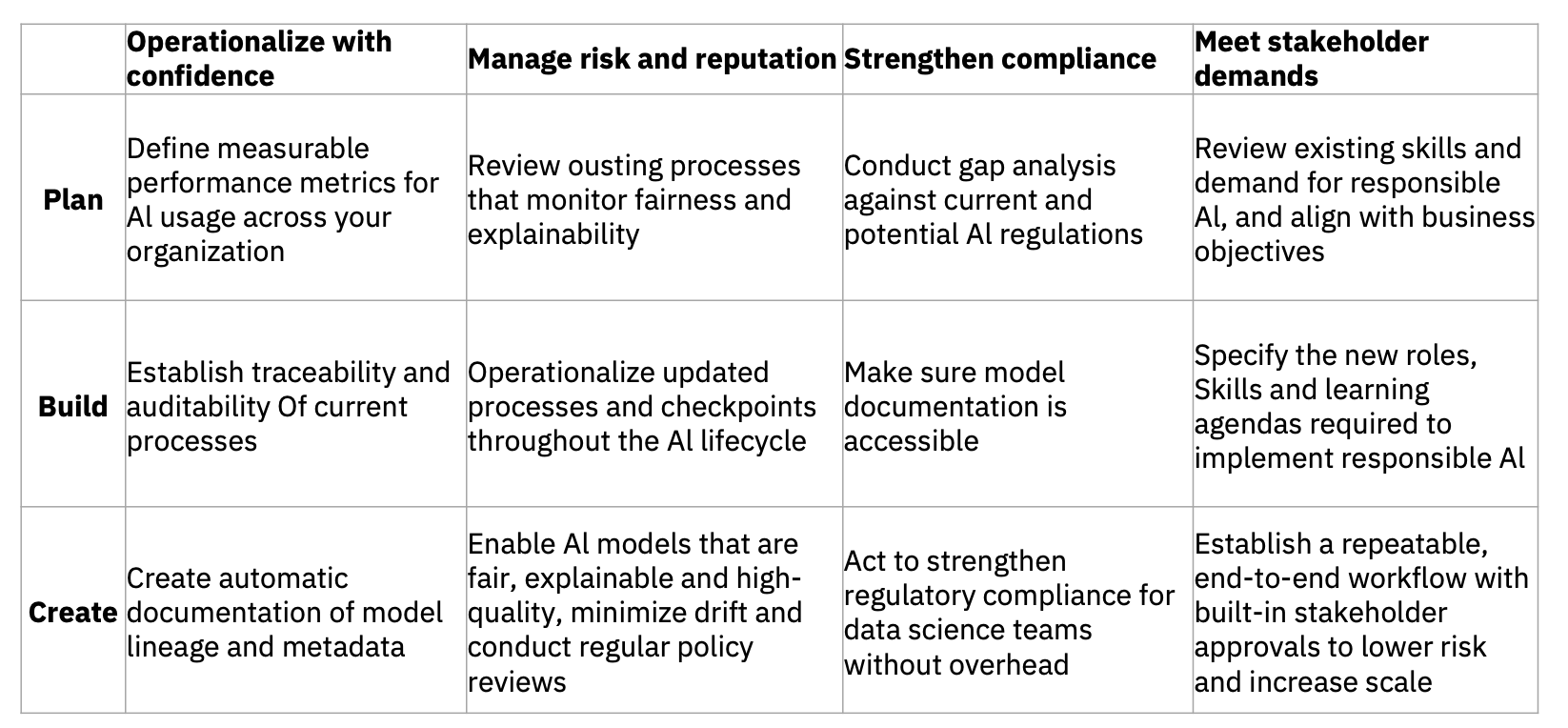 A framework for responsible, governed AI
IBM watsonx.governance includes capabilities for holistic AI governance: lifecycle tracking with automated metadata documentation; evaluation, monitoring, and explainability; risk management and compliance and is designed to address broad set of stakeholders engaged in implementing AI Governance in enterprise.
End-to-End AI Lifecycle Governance: AI governance requires input from multiple stakeholders on data, model considerations, and output from the model. The model lifecycle goes through various domains: business problem, data identification and integration, model development, training, testing and tuning, risk assessment, deployment, and model operations involving technical and non-technical stakeholders. The decision-makers in each of the phases of the lifecycle must have access to timely insights and metrics to speed time to value in addition to having an end-to-end automated process. Watsonx.governance automatically captures metadata like the training data and frameworks used to build the model, along with evaluation information as the model progresses from use case request to development to test to deployment. That data is made available to approvers, ensuring that decision-makers have a complete picture of the model’s lineage and performance.
Risk Management: Manage risk and protect reputation by automating workflows to ensure quality and better detect bias and drift. Before organizations can trust AI to make business decisions or interact with customers, they must understand and quantify the risks that AI presents and be able to measure the AI’s performance to monitor their risk exposure.
Regulatory Compliance: Adhere to compliance requirements and ensure effective controls. Manage internal policies and procedures, industry standards and regulation to ensure responsible AI adoption. Mounting government regulation of AI poses serious problems for organizations hoping to adopt AI without a comprehensive, configurable governance system in place. It also provides the ability to explain and inspect outputs to determine what the outputs may be based on.
There has been rapidly growing adoption of watsonx.governance to manage and govern foundation models across hybrid cloud and public cloud environment. Working collaboratively with Microsoft on our strategic partnership, we are excited to announce that IBM watsonx.governance is supported by IBM to run on Microsoft Azure and is available to purchase through IBM and our business partner ecosystem, running on Azure Red Hat OpenShift (ARO) or as a customer-managed solution on Red Hat OpenShift on Azure. Organizations are also able to transact on Azure Marketplace to procure watsonx.governance. Organizations can leverage the power of IBM’s Hybrid Cloud approach to run watsonx.governance anywhere via RedHat OpenShift and complement with Azure Data and AI native services to meet business goals and objectives for AI lifecycle governance, risk management, and regulatory compliance.
Use cases
With watsonx.governance, organizations can operationalize AI governance to augment and complement their existing build and deploy stack. Models are automatically documented and validated before deployment. Once live, they are continuously monitored for quality and adherence to policies. Detailed documentation is available for auditors to inspect how models work and an AI Factsheet automatically captures metadata showing training parameters, instructions, input, and metrics captured at build, validation, and deployment.
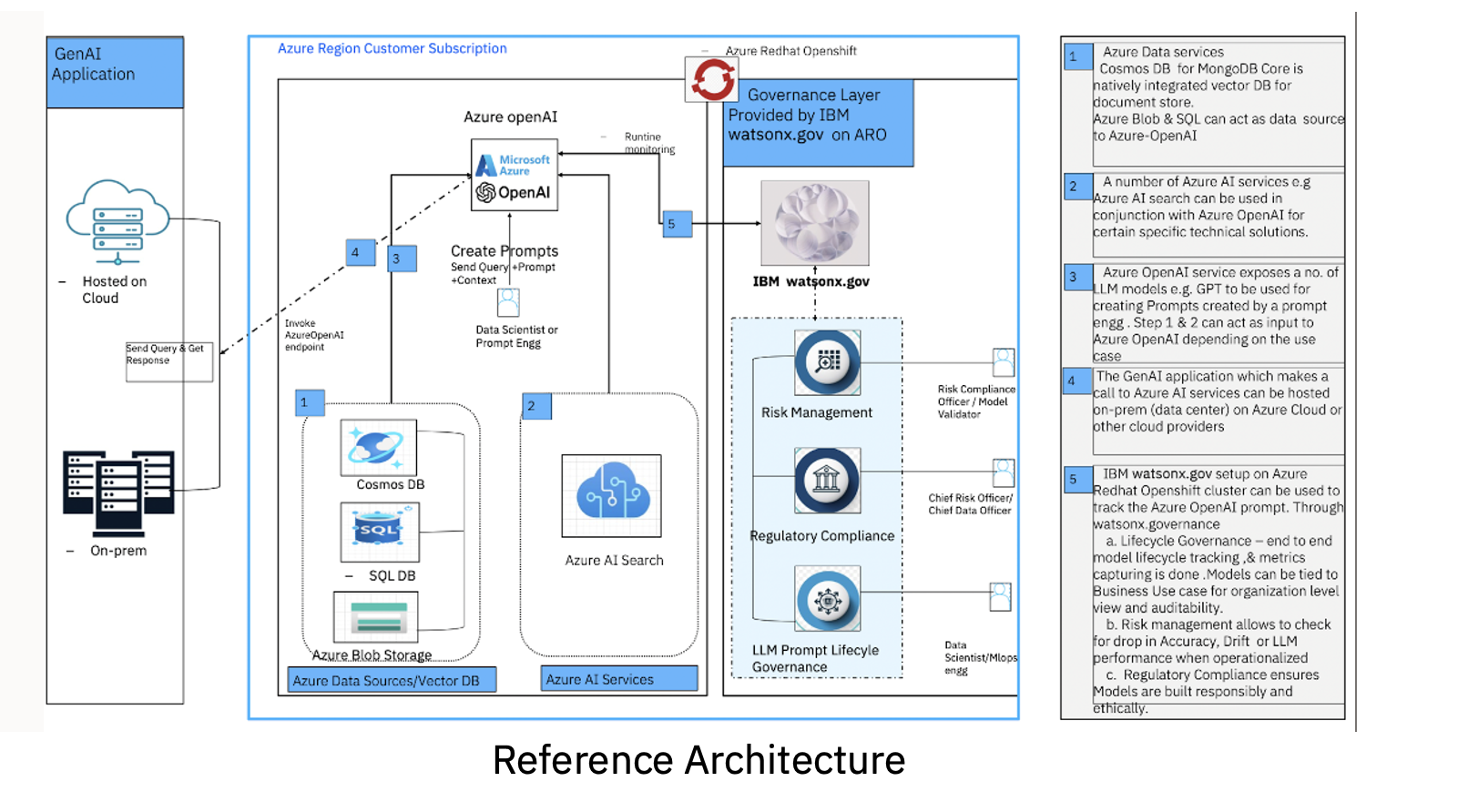
IBM watsonx.governance on ARO can be deployed on Azure and model metadata and evaluation metrics can be collected from Azure OpenAI service or other LLMs by watsonx.governance. Model validators and model developers review and track models through watsonx.governance.
Use IBM watsonx.gov to monitor drift for traditional ML and LLMs: An LLM’s response can vary or drift due to changes in the real world, affecting accuracy. Over the period of the model operation, incoming data into prompts can change in structure and context. IBM watsonx.governance can detect LLM drift from metadata drift and content and confidence drift, and alert stakeholders of developing problems.
Monitor for toxic language and PII in prompt inputs and outputs; detect hallucination: With watsonx.governance, you can monitor prompt input and output for toxic language and PII (personally identifiable information). It can also help you ascertain if responses are hallucinating and measure quality of responses. For text classification and predictive ML, watsonx.governance doesn’t just detect bias but can also automatically de-bias.
Helps you meet compliance requirements: Most governance frameworks lack the ability to define workflow and processes, which can vary depending on organization needs. IBM watsonx.governance includes out-of-the-box function to define workflow and processes for better compliance and track all metadata for improved auditability. A user can define workflows and processes and the workflow can be reviewed by different personas and stakeholders. Users can track model and LLM metadata and metrics along the lifecycle for detailed auditability. In addition, through the use our EU AI Act applicability assessments, you are able to determine the scope and risk classification of each use case in line with the guidance of the pending EU AI Act legislation.
AI risk identification: The rapid adoption of generative AI has seen a corresponding increase in both the volumes and types of risks that firms are facing. Watsonx.governance users can leverage the IBM AI Risk Atlas content through a guided response to a pre-defined questionnaire that deploys specific risk instances to each use case based on the assessment of the use case owner. Each risk can then undergo assessment and documentation of mitigation controls and actions.
Next steps
Create responsible, transparent, and explainable AI workflows with the IBM watsonx.governance toolkit—without the costs of switching from your current data science platform.